
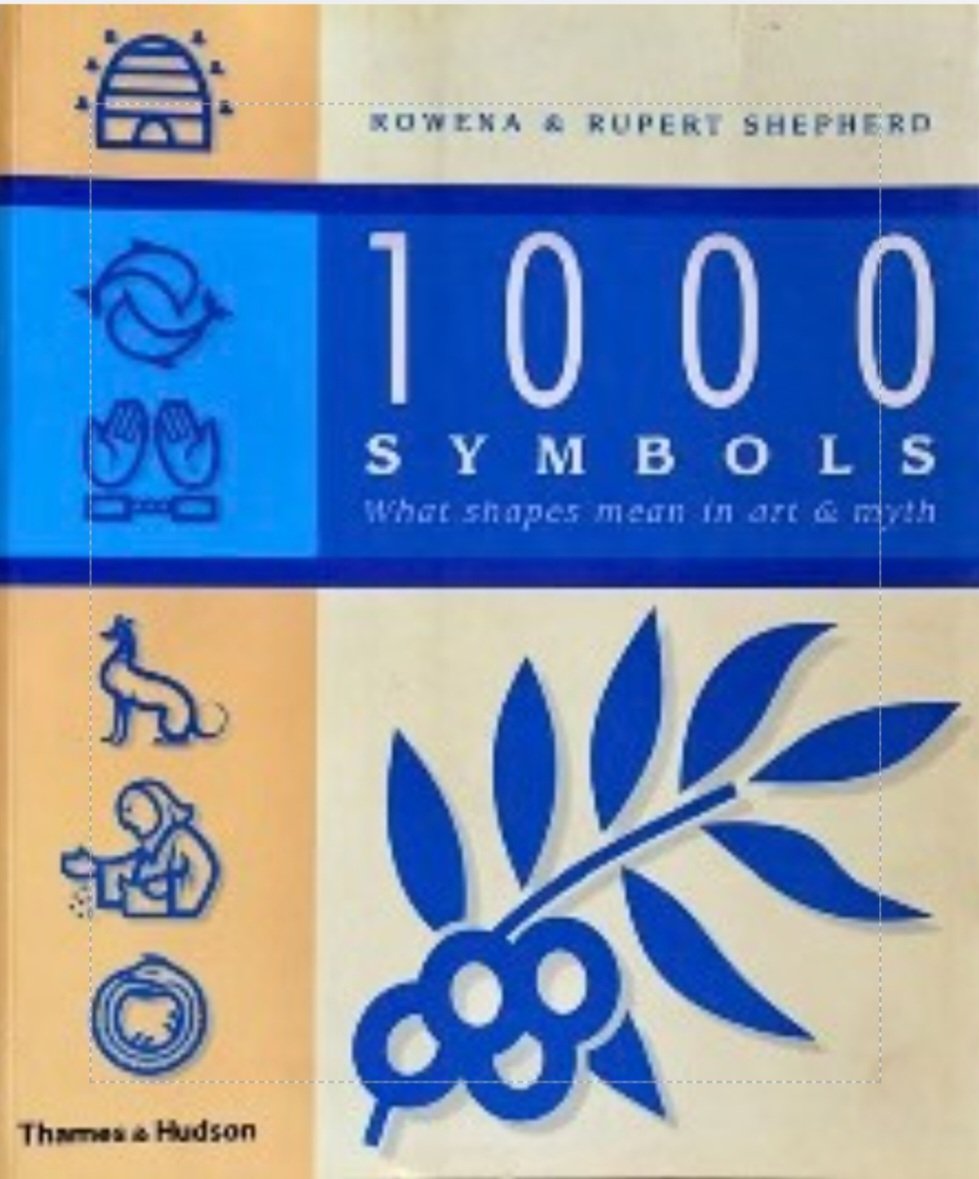
Author: Rowena & Rupert Sheppard, 2002. 352pgs. (English). Softcover
Publisher: Thames and Hudson, London
The volume constitutes a concise, systematically organized single-volume dictionary that deciphers approximately one thousand widely recognized symbols spanning history, religion, and diverse global cultures. It opens with an alphabetical, cross-referenced index, followed by a series of thematically delineated sections: Geometrical shapes: foundational forms such as circles, squares, triangles, and spirals, examined as archetypal design elements. The Universe and the Elements: natural forces, celestial bodies, and temporal cycles. Characters, People, and Living Creatures: human attributes, historical personages, animals, birds, and insects. Mythical beasts and flora: legendary hybrids such as centaurs, alongside trees and flowers imbued with symbolic resonance. Objects, colors, and numbers: man-made artifacts, chromatic associations, and numerical signification. Among its principal strengths is the deliberate avoidance of a Eurocentric or monolithic interpretive lens. The text demonstrates, for instance, how symbols such as the cross or swastika undergo radical semantic transformations across Buddhist practice, art-historical discourse, and occult traditions. Another notable merit lies in the brevity and clarity of entries, each accompanied by lucid illustrations, rendering the work a practical reference for readers, students, and art therapists rather than a comprehensive scholarly compendium. Its limitations, however, stem from the compression of 1,000 entries into 352 pages. Individual entries function primarily as introductory glosses, offering accessible points of entry into symbolic traditions rather than sustained academic exegesis. Consequently, the dictionary excels as a portable guide and visual reference, yet remains circumscribed in depth for advanced research.
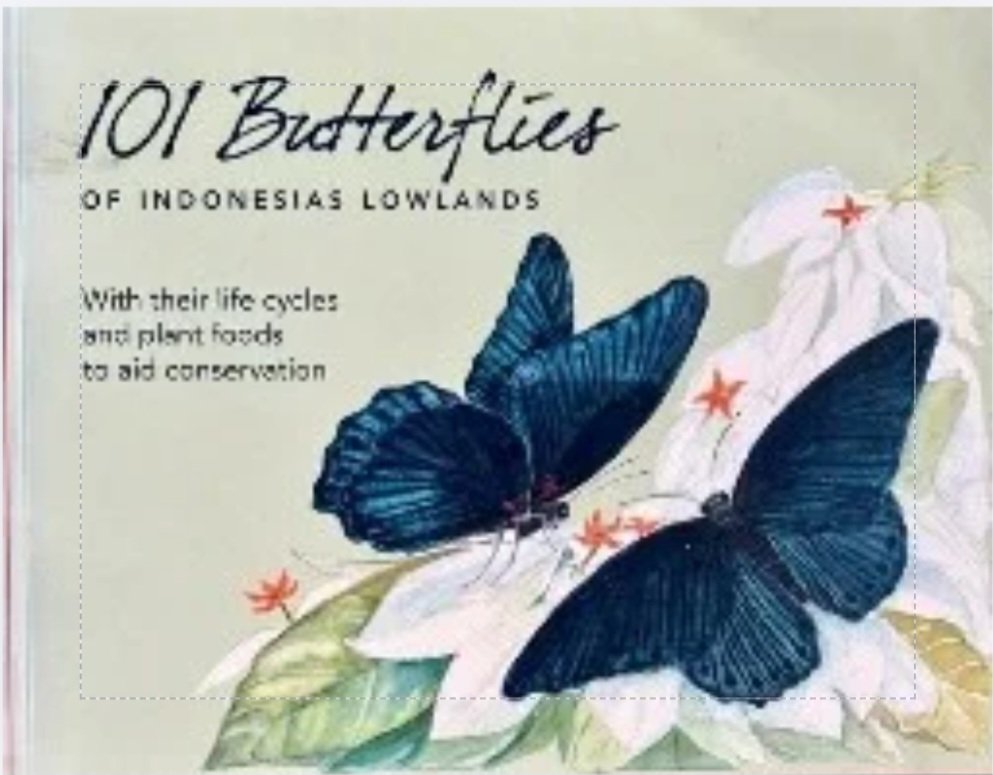
Author: Meryl Wilson, 2008. 146pgs. (English), Softcover
Publisher: Yellow Dot, Jakarta Indonesia
This volume constitutes a visually captivating introduction to the lepidopteran world, enriched by the author’s delicate watercolor illustrations and complementary photographic documentation. Wilson conceives the book as a practical handbook, guiding readers through the manifold dimensions of a butterfly’s life cycle: its biological processes, ecological significance, and symbolic resonance. She elucidates why butterflies matter—not merely as aesthetic marvels, but as vital indicators of biodiversity, environmental health, and the impact of pesticides or climatic change. The text highlights the sophisticated strategies of butterfly defense. Warning coloration in hues of red, black, white, yellow, or blue signals toxicity, while camouflage and cryptic patterning allow others to merge seamlessly with their surroundings. Some species even minimize their shadow by aligning with the sun, a subtle adaptation underscoring evolutionary ingenuity. Equally remarkable are the eggs, which Wilson describes as architectural microstructures. Reinforced by ribbing or spines, they withstand heat, cold, precipitation, and predation. Their scale ranges from invisible specks discernible only under magnification to forms reaching three millimeters in diameter. The author further examines the sensory and physiological capacities of the caterpillar—its ability to see, taste, smell, breathe, move, spin silk, moult, and excrete—thereby situating the larval stage as a complex organism in its own right. Wilson does not neglect the threats confronting butterflies. Natural adversaries include viruses, bacteria, birds, spiders, pray-mantises, geckos, frogs, and predatory insects, while anthropogenic pressures such as habitat destruction and extreme heat exacerbate vulnerability. She also catalogues the flora essential to sustaining butterfly populations, identifying nectar-rich blossoms attractive to adults and host plants indispensable for caterpillars. Her ethnographic attention to Bali’s Bukit region—a dry limestone landscape with minimal rainfall—anchors the study in a specific ecological and cultural milieu, reflecting the lived environment in which her research unfolded. Ultimately, this book serves as an engaging and educational introduction to the butterflies of Indonesia. While not exhaustive in its scientific detail, it succeeds in sparking curiosity and appreciation among readers, inviting them to contemplate the fragile beauty and ecological importance of these creatures. In doing so, Wilson contributes both to public awareness and to the broader discourse on biodiversity conservation.
Author: Santoso Chandramuljana, 2004, 104pgs. (Indonesian) Softcover
Publisher: Gramedia Pustaka Utama. Jakarta
138 Tanya Jawab Feng Shui presents itself in a question-and-answer format, offering an accessible introduction to the ancient Chinese art of Feng Shui. The author systematically dismantles the common misconception that Feng Shui is a mystical, superstition-laden practice in conflict with religious belief. Instead, the text frames Feng Shui as a cultural framework and environmental science, designed to harmonize energies—such as yin and yang and the five elements (metal, water, wood, fire, and earth)—to optimize human prosperity and happiness. By structuring the book into 138 discrete questions and answers, the author addresses everyday, practical concerns. This bite-sized organization makes the material remarkably approachable for beginners, who might otherwise feel overwhelmed by complex theories. The book excels in confronting fear and skepticism: it cautions readers against manipulative uses of Feng Shui by unscrupulous actors and redirects attention away from “bad omens” toward pragmatic strategies for spatial optimization. Furthermore, it delineates the diverse schools and streams of Feng Shui, underscoring the practice’s plurality rather than presenting it as rigid or monolithic. One limitation lies in the text’s relative superficiality. Because it spans 138 broad questions, advanced practitioners may find the content lacking in depth. It functions more as a foundational handbook than as an advanced guide for professional architectural or spatial analysis. Originally published in 2004, the volume naturally omits contemporary cultural contexts and design aesthetics, such as the integration of smart home technologies with Feng Shui principles. Nevertheless, 138 Tanya Jawab Feng Shui remains an excellent introductory resource for those curious about how environmental alignment influences daily energy. It strips away unnecessary mysticism and delivers straightforward, logical answers. For readers seeking a concise, well-structured reference to begin their journey into spatial harmony, this classic text is highly recommended.

Author: Madeleine Orban Szontaqh, 1993. 46pgs. (English). Softcover
Publisher: Dover Publications, New York
"This booklet constitutes a carefully curated reference volume, functioning primarily as a straightforward pictorial sourcebook. It provides readers, researchers, and practicing artists with a systematically organized collection of royalty-free line drawings that visually document traditional Native American art forms. Beyond its utility as a design resource, the compilation serves as a cultural archive, preserving motifs and iconographic elements that are deeply embedded within Indigenous aesthetic traditions. By presenting these forms in accessible line art, the booklet not only facilitates artistic adaptation but also underscores the enduring significance of Native American visual heritage within broader discourses of ethnographic study and cross-cultural artistic practice."

Author: NN, 2012. 12pg. (Indonesian)
Publisher: Musium Tekstil Jakarta
This small book commemorates Asmoro Damais’ journey with batik. It starts with a concise biography and delves into her profound love for batik, kebayas, and batik home furnishings. It also emphasizes her strong passion for batik fashion, cultivated in partnership with Iwan Tirta and Prajudi. This book confidently showcases her unwavering dedication to all things batik.
Page 1 of 151