

Author: see below.
Publisher: The Asian Arts Society of Australia, NSW, Australia
This issue of the quarterly magazine interrogates the manifold practices of corporeal adornment, situating clothing and fashion as dynamic sites of cultural inscription and identity formation. The essays gathered here traverse diverse geographies and historical moments, foregrounding the body as both canvas and agent in the negotiation of social meaning. By engaging with sartorial traditions, textile innovations, and modes of bodily presentation, the contributors collectively illuminate how adornment functions as a language of power, resistance, and self-fashioning. Marianne Hulsbosch’s Dedicated Followers of Fashion examines the semiotics of dress as a marker of cultural allegiance, while Toby Stade’s Anachronistic Masculinity juxtaposes the martial aesthetics of samurai armour with the performative dandyism of late Edo Japan. Mariah Waworuntu’s study of Traditional Childhood Practices in the Indonesian Archipelago underscores the formative role of adornment in shaping communal identity from an early age. Pattaratorn Chirapravati’s The Stylist Regents explores the refashioning of royal Thai sartorial styles, revealing the interplay between gender, authority, and aesthetics. Peter McNeil’s Cool Men situates Indian cottons within global circuits of allure and consumption, while Elly Kent’s Cloaked Identity interprets Mella Jaarsma’s artistic interventions as metaphors of healing, feeding, and warriorhood. Shih Ying Lin’s Reflecting Social Change traces the evolution of women’s clothing in postwar Taiwan, mapping the garment as a register of shifting social values. Gael Newton’s A Modern Self considers Japanese vernacular studio portraits as visual negotiations of modernity, and Jackie Menzies’ Collector’s Choice analyzes a Yokohama triptych as a lens through which the unfamiliar is both depicted and domesticated. Together, these contributions articulate a richly textured discourse on the aesthetics of the body, demonstrating how adornment mediates between tradition and modernity, individuality and collectivity, local specificity and transnational exchange. This volume thus advances the scholarly conversation on fashion and identity, positioning sartorial practices as critical to understanding cultural history and social transformation.
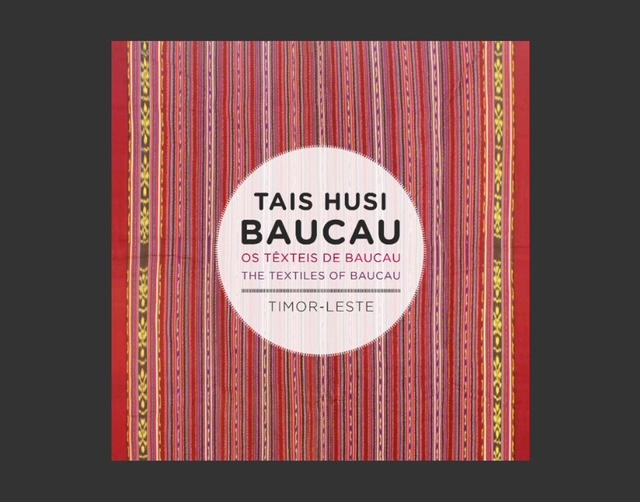
Author: Secretary of State for Arts and Culture in Timor Leste, 2018.
Publisher: Timor Aid 2018. Pg. (English Portuguese, and Tetum)
This book is published in a series on the traditional textile production of Bacau district, one of the 13 municipalities of Timor Leste.
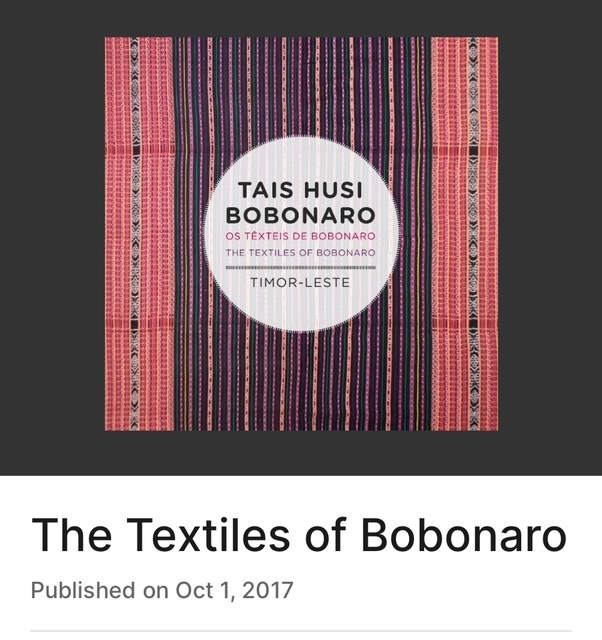
Author: Secretary of State for Arts and Culture in Timor Leste, 2017.
Publisher: Timor Aid 2017. Pg. (English Portuguese, and Tetum)
This book is published in a series on the traditional textile production of Bobonaro district, one of the 13 municipalities of Timor Leste.
Author: Yanuardi Syukur et al. 2020. 237pg. (English)
Publisher: Negri Rempah Foundation, Jakarta
The book examines the critical maritime role of the Indonesian archipelago in the spice trade's history. It highlights key regions, including Barus, the oldest kingdom in Java; Pasai, a prominent spice center on the coast of Sumatra; Makassar, a vital hub for commercial shipping; and Papua, a once-thriving spice emporium. These stories assert the islands' significant contributions and maritime prowess in their historical context.
Author: Nyoman Sadra Dharmawan, 2010. 166pgs. (Indonesian) Softcover
Publisher: Udayana University Press, Denpasar, Bali
The present volume offers a comprehensive encyclopedia of plants utilized in Balinese ritual offerings, or upakara. Within the Hindu Balinese worldview, ritual practice is inseparable from the philosophical doctrine of Tri Hita Karana, which articulates the pursuit of happiness through the cultivation of harmony with the divine, with fellow human beings, and with the natural environment. This cosmological principle underscores the ethical imperative that humanity must preserve and protect nature, a mandate deeply embedded in the canonical scriptures of the Reg Weda. Despite the centrality of upakara in Balinese religious life, systematic documentation of the plants employed in these offerings has remained absent in modern scholarship. The urgency of this endeavor is heightened by the fact that several of these species now face the threat of extinction, thereby endangering not only ecological diversity but also the continuity of cultural heritage. This encyclopedia seeks to address this lacuna by presenting detailed morphological descriptions of the plants, explicating the philosophical meanings ascribed to each species, and identifying the geographical contexts in which they are collected. The significance of this work extends beyond academic inquiry. It serves as a vital resource for practitioners who fashion ritual offerings as part of their livelihood, as well as for those who aspire to engage in the practice with deeper intellectual and spiritual awareness. By bridging ethnobotanical knowledge with cultural philosophy, this volume contributes to the preservation of Balinese tradition while fostering a broader understanding of the interdependence between ritual, ecology, and human well-being.
Page 81 of 108